


Face
Read about Laser Resurfacing
Laser Resurfacing
Opus Plasma and Aerolase Era in full detail.
Details
Monday to Friday, 8:30 am to 3:30 pm (904) 686-7771
Facial rejuvenation
Ice pick, boxcar and rolling scars treated by a double board-certified dermatologist, with resurfacing chosen for your scar type and your skin tone.
Acne scars form when a deeply clogged, inflamed pore ruptures and damages the tissue around it. If the skin repairs that damage with too little collagen, a depressed (atrophic) scar is left behind: ice pick, boxcar or rolling. Topical products cannot repair these scars. Procedures that remodel collagen can, including Opus Plasma, Aerolase lasers, microneedling and chemical peels.
Scarring usually follows moderate to severe acne. Picking and squeezing make it more likely, because they force bacteria and debris deeper into the skin and damage the surrounding tissue.
Because a scar is a permanent change in the skin's structure, deep scars are difficult to remove completely. Modern treatments can reduce scar depth, smooth texture and make scars much less noticeable. Dr. Cappel sets realistic expectations at your consultation.
If you are still breaking out, active acne comes first. Treating it promptly is the best way to prevent new scars, and some treatments, such as Aerolase Neo and chemical peels, address active acne and scars together.
Treatment options
The right option depends on the type of scarring, your skin type and how much downtime you can take. Combining treatments is often the most effective plan.
Fractional plasma resurfacing for ice pick, boxcar and rolling scars, with results comparable to CO2 laser and 3 to 5 days of downtime. Safe for darker skin tones. See laser resurfacing.
A 2940nm Er:YAG laser peel that ablates scar tissue and stimulates deep collagen remodeling. Many patients see dramatic results from one or two treatments.
A gentle, no-downtime laser that treats active acne and improves scars at the same time, with gradual improvement over several months as new collagen forms.
Collagen induction therapy that helps fill in and smooth depressed scars and enlarged pores. See microneedling.
Customizable peels that clear active acne, improve scars and fade the dark marks acne leaves behind. See chemical peels.
A prescribed daily regimen that prevents new breakouts and fades scars and dark marks. See medical-grade skincare.

Acne scarring involves permanent changes to the skin's structure, which is why creams and serums cannot repair deep scars. Effective treatment has to stimulate new collagen and remodel the skin, which is what lasers, plasma resurfacing, microneedling and peels do.
Scars also differ. Ice pick, boxcar and rolling scars are all atrophic (depressed), but they sit at different depths and respond to different energy, so Dr. Cappel examines your skin before recommending a device or a combination.
Opus Plasma uses fractional radiofrequency to create plasma sparks that ablate tiny channels in the skin while heating the deeper dermis. It treats only a fraction of the surface, so healthy skin in between speeds healing. Most patients need 3 to 4 treatments spaced 4 to 6 weeks apart, with 3 to 5 days of downtime each.
Aerolase Era is a 2940nm Er:YAG laser with a 300-microsecond pulse that removes damaged layers with micron-level precision and limited heat to the surrounding skin. New skin forms in 2 to 3 days, total downtime is 3 to 7 days, and most patients reach their result with 1 to 2 treatments spaced 6 to 12 weeks apart.
With both, improvement shows once healing is complete at 1 to 2 weeks and continues for 3 to 6 months as collagen remodels.

Several are, and choosing between them is part of the consultation. Opus Plasma is safe for all Fitzpatrick skin types (I to VI) because its radiofrequency energy bypasses the melanin in the top layer of skin, which lowers the risk of hyperpigmentation. That makes it an ablative option for darker skin.
Aerolase Neo is designed to be safe for all skin types, including darker tones. Aerolase Era can be used on skin types IV to VI with conservative settings, although lighter skin carries less risk of hyperpigmentation, and very dark skin needs careful evaluation. Aggressive lasers and deeper peels carry a higher risk of dark marks in darker skin, so Dr. Cappel matches the treatment to your skin.
Treatment overview
Dr. Cappel evaluates your scars with Alma IQ skin analysis, reviews your medical history and recommends a protocol.
Avoid sun, tanning and self-tanner for 4 to 6 weeks and stop retinoids 1 to 2 weeks before. An antiviral may be prescribed if you get cold sores.
Numbing cream goes on 30 to 60 minutes ahead. Treatment takes about 30 to 60 minutes, with warmth and a prickling sensation.
Skin is red and swollen at first, then bronzes, flakes and peels as new skin forms. Gentle cleansing and healing ointment are required.
Peeling finishes by about day 7 and makeup can be applied once skin has healed. Pinkness fades over 2 to 4 weeks.
Collagen keeps remodeling, so scar depth and texture improve progressively, with most patients seeing clear change in 3 to 6 months.
Suitability
Still breaking out? Start with acne treatment. For device detail, see laser resurfacing and microneedling.
Compared
| Treatment | Primary target | Downtime | Best for |
|---|---|---|---|
| Opus Plasma | Ice pick, boxcar and rolling scars | 3 to 5 days | Significant scar correction, including darker skin |
| Aerolase Era | Deep scars, texture, sun damage | 3 to 7 days | Dramatic resurfacing in 1 to 2 treatments |
| Aerolase Neo | Active acne and acne scars | None | Pain-free treatment for all skin types |
| Chemical peels | Active acne, scars, dark marks | A few days to a week | Customizable depth for acne and scarring |
| Medical-grade skincare | Active acne, prevention, scars | None | Long-term control alongside in-office care |
Cost
Cost depends on the treatment and the area. Opus Plasma is typically $800 to $1,500 per full-face session, with package pricing for a series of 3 to 4. Aerolase Era full-face resurfacing is typically $1,500 to $3,500 per session, and smaller areas or lighter peels cost less. Aerolase Neo is typically $300 to $600 per session. Peel and microneedling pricing is provided at consultation.
| Treatment | Typical range | Sessions |
|---|---|---|
| Opus Plasma, full face | $800 to $1,500 | 3 to 4, spaced 4 to 6 weeks |
| Aerolase Era, full face | $1,500 to $3,500 | 1 to 2, spaced 6 to 12 weeks |
| Aerolase Neo | $300 to $600 | Per session |
Costs vary with the number of sessions and the areas treated. We give you transparent pricing at your consultation, before any treatment. Cost and payment options

Who performs this
Double board-certified dermatologist and dermatopathologist
Dr. Cappel assesses the type and severity of your scarring, reviews your medical history and skin type, and builds the resurfacing protocol himself, so the treatment fits your scars and keeps risk low.
Read full profileQuestions
Deep acne scars are difficult to remove completely, but treatments such as Opus Plasma, Aerolase and chemical peels can reduce scar depth, smooth texture and make scars much less noticeable. Dr. Cappel gives realistic expectations at your consultation. Our guide to acne scars explains more.
Results are gradual because new collagen takes time to form. After resurfacing, improvement shows once the skin heals at 1 to 2 weeks, and most patients see noticeable change in scar depth and texture within 3 to 6 months.
It depends on the device. Opus Plasma usually takes 3 to 4 treatments spaced 4 to 6 weeks apart. Aerolase Era often takes 1 to 2 treatments spaced 6 to 12 weeks apart, and a single treatment can be enough.
Opus delivers results comparable to CO2 laser with much less downtime (3 to 5 days instead of 7 to 14) and a lower risk of complications, particularly for darker skin types.
Yes, with the right choice of device. Opus Plasma is safe for all Fitzpatrick skin types because its energy bypasses surface melanin, and Aerolase Neo is designed for all skin types. Aerolase Era can be used on darker skin with conservative settings.
Yes. The sooner acne is under control, the less likely it is to cause deep inflammation and permanent damage. Avoiding picking and squeezing is also critical. See acne treatment.
After Aerolase Neo you can usually apply makeup right away. After Opus Plasma, Aerolase Era or a medium-depth peel, wait until the skin has healed, typically 5 to 7 days for resurfacing.
Yes. Combining in-office procedures with medical-grade skincare is often the most effective approach to acne and scarring. Dr. Cappel designs and sequences a plan around your skin.
Where
At our office at 100 Executive Way, Suite 114, Ponte Vedra Beach, under the care of Dr. Cappel, a double board-certified dermatologist and dermatopathologist.
Patients see us from Ponte Vedra Beach, Ponte Vedra, Nocatee, Jacksonville Beach, Atlantic Beach, Neptune Beach, Jacksonville, St. Augustine and Palm Coast and across Northeast Florida.
Also consider
Opus Plasma and Aerolase Era in full detail.
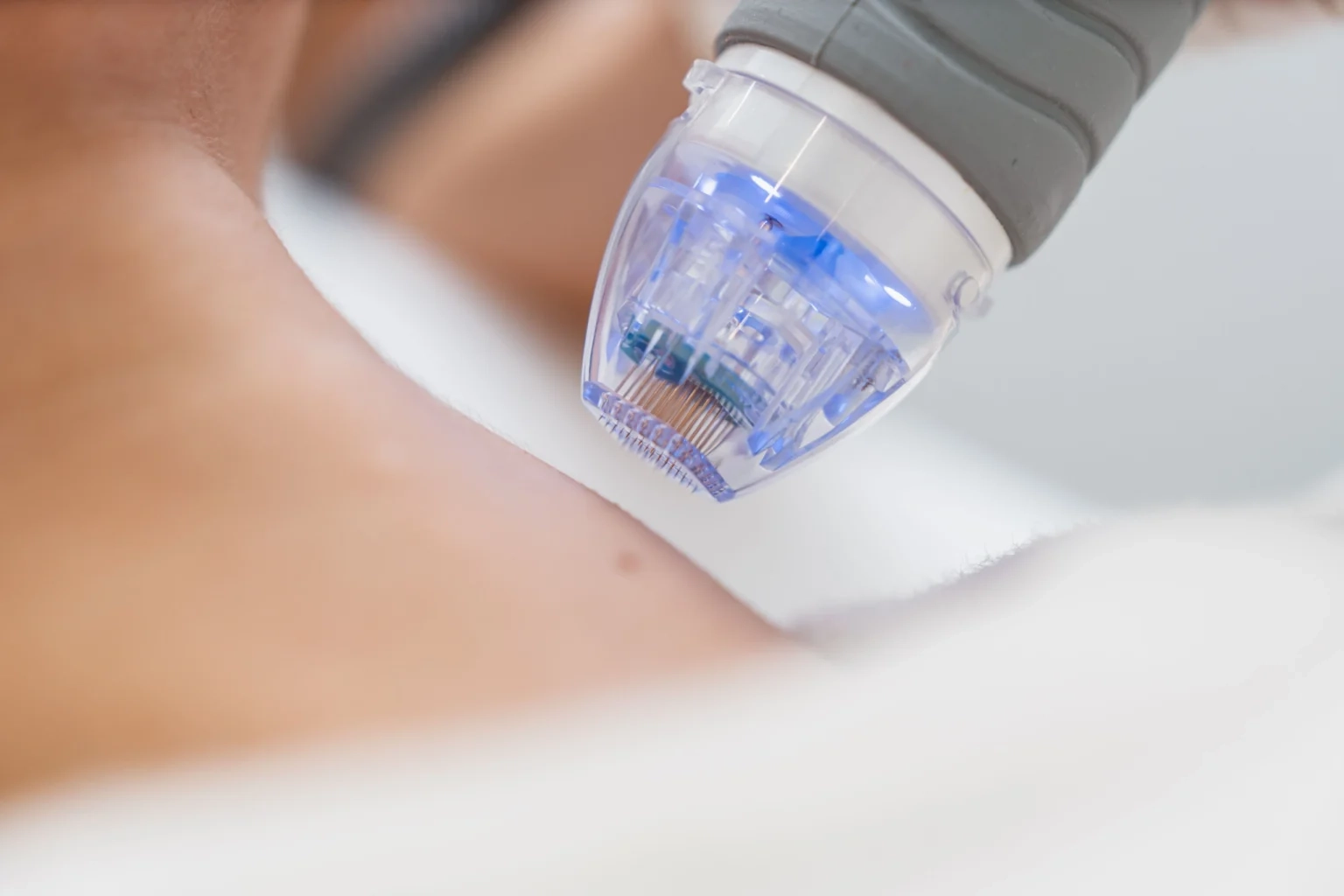
Collagen induction for depressed scars and pores.

Clear active breakouts first to prevent new scars.
Book a visit
Dermatology visits, aesthetic consultations and wellness plans all start the same way: a careful assessment by Dr. Cappel and a plan built around your skin, your health and your goals.